

One of the lesser-known weapons of the Vietnam War was an integrally suppressed variant of the Carl Gustaf m/45B submachine gun. Manufactured in Sweden and chambered for 9x19mm NATO, the m/45B, commonly known to U.S. users as the “Swedish K,” had already earned a reputation for ruggedness and mechanical simplicity by the time conflict expanded in Southeast Asia. Its straightforward blowback action, stamped-steel tube construction, and simple controls made it popular with operators who needed a compact, reliable firearm that would keep working under the rough conditions of jungle warfare.

Captured or recovered Swedish K’s. By Lynndon Schooler.
The Gun
The nickname “Swedish K” is a direct translation from “Swedish submachine gun”. However, the version that found its way into covert operations during the 1960s and ’70s was not a factory-standard model. Instead, select examples were fitted with an integral suppressor based on the same basic principles as the Office of Strategic Services (OSS) silencer developed in the United States during World War II. Rather than relying on an add-on can, the integrally suppressed Swedish K used a ported or vented barrel to vent propellant gases into an enclosed expansion chamber filled with a mesh roll and stacked mesh discs. Those internals cooled and slowly bled off gases, reducing muzzle blast and making each shot significantly quieter than an unsuppressed 9mm report.

Swedish K suppressor. By Lynndon Schooler.
Quiet in this context is relative; the suppressed Swedish K produced a muffled, subdued signature that could be masked by ambient jungle noise and reduced how far that noise traveled. That reduction in report could mean the difference between surprise and detection for clandestine teams operating behind enemy lines. Equally important was the weapon’s proven durability: the Carl Gustaf design tolerated field abuse and dirty conditions, and when combined with a well-built integral suppressor, the package became a dependable tool for special operations.

m45/B receiver. By Lynndon Schooler.
In Vietnam
The suppressed Swedish K was particularly attractive to CIA folk, members of Naval Special Warfare, and MACV-SOG (Military Assistance Command, Vietnam, Studies and Observations Group). MACV-SOG was a highly secretive organization that conducted cross-border reconnaissance, direct-action raids, and black operations in Laos, Cambodia, and North Vietnam. Such missions demanded compact, reliable, and, when needed, quiet weapons. In these contexts, a suppressed 9mm submachine gun offered several advantages: it allowed teams to neutralize sentries and small groups with minimal noise, kept muzzle flash and signature low during night engagements, and used a widely available cartridge suitable for short-range engagements and close-quarters fighting.
Throughout the war, U.S. Special Forces and intelligence units routinely employed nonstandard, modified, or locally procured weapons tailored to mission needs. From captured weapons repurposed for infiltration to customized firearms crafted by manufacturers, operators were pragmatic in matching tools to tasks. The suppressed Swedish K fit neatly into that practice. Its design was simple enough to maintain in the field, and its foreign origin provided a layer of deniability, an essential consideration for covert operations that U.S. policymakers could not openly acknowledge. If a suppressed Swedish K were recovered by hostile forces, it would not immediately identify American involvement in the same way an obviously U.S.-manufactured weapon might. But as the war went on, this was less of a concern, as U.S. weapons were everywhere.

Brought out some guns for a YouTuber to make videos on the Swedish K and AK-12. By Lynndon Schooler.
The weapon’s suppressed configuration owes a clear debt to earlier U.S. work on silencers. The OSS suppressor for the M3 Grease Gun had demonstrated how a compact, integral suppression system could marry quiet operation with a serviceable submachine gun. For clandestine units operating in South East Asia’s dense, wet environments, a similar approach made logical sense. Ported barrels combined with a series of baffles or mesh elements offered a robust suppression method that could be integrated into the weapon without compromising its balance or compactness, qualities essential for jungle patrols, riverine insertions, and long-range recon teams.
The suppressed Swedish K was not a mass-issued equipment. Instead, it circulated within a narrow community of special operators and intelligence specialists who judged its advantages worth the cost. Its uses were situational: sentry elimination, quiet overwatch during ambushes. The weapon rarely appeared on conventional fireteam loadouts; instead, it was a specialist’s tool, selected for missions where stealth and short-range lethality were prioritized over sustained automatic fire.
Because these weapons were used covertly, documentation about their procurement and employment is thin. A complete, declassified paper trail is lacking; much of what is known comes from photos, museums, and scattered archival material. As a result, the paper trail of the suppressed Swedish K remains partially obscured, its story told in fragments rather than a neat official history. This lack of clarity contributes to the weapon’s mystique: it occupies an edge of the historical record where uniforms, unit citations, and after-action reports give way to darker, more ambiguous stories of espionage and covert warfare.

Two m45/B Swedish Ks. By Lynndon Schooler.
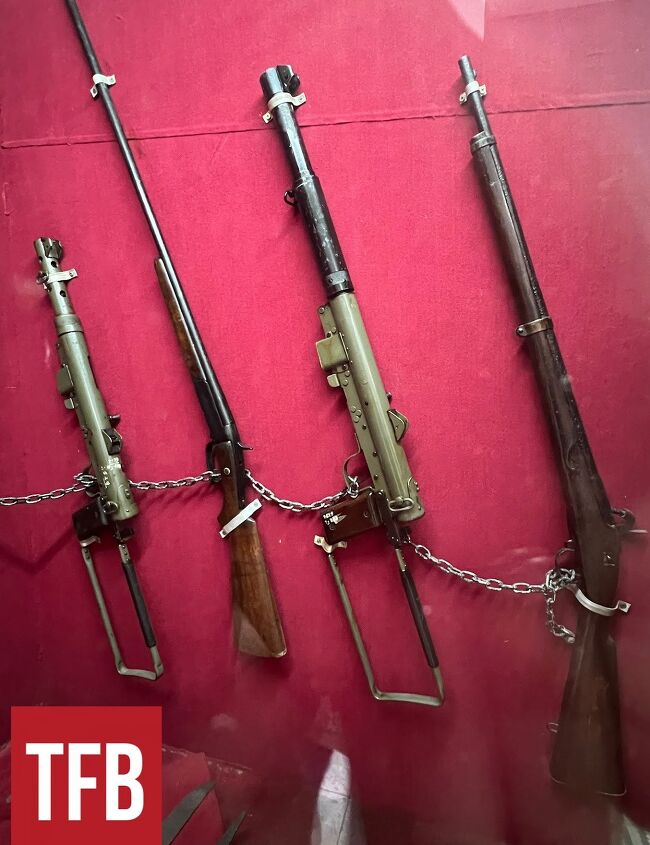
One surviving example of a suppressed Swedish K displayed in Vietnam is at the Ho Chi Minh Trail Museum in Da Nang. This museum is not far from where the MACV-SOG CCN (Command & Control North), based at Da Nang near the Marble Mountains, was located during the war. It stands as a material witness to the shadowy side of the war. As an artifact, the weapon symbolizes a quieter, less visible dimension of the conflict: small, precise engagements conducted by elite teams whose work rarely featured in public accounts. The suppressed Swedish K, in its way, speaks to the ingenuity and improvisation that characterized much of the clandestine actions during the Vietnam War.
In the broader scope of military history, the integrally suppressed Carl Gustaf m/45B is a reminder that technology and tactics often adapt in parallel to the conditions of conflict. When noise equals detection and discretion can save lives, silence becomes a weapon in its own right. The Swedish K’s suppressed variants were not glamorous or widely famous, but for the handful of operators who relied on them, they were indispensable tools, quiet, reliable, and perfectly suited to the hidden battles of the jungle.

Sub gun post sample builds. By Lynndon Schooler.
Final thoughts
The Swedish K remains one of my all-time favorite submachine guns, not only because of its reliability and iconic design but also because of its remarkable history. That legacy was a major reason I decided to track down a kit and take the time to build it into a dealer sample of my own, allowing me to preserve and experience a small piece of that history firsthand.