Good afternoon, everyone, and welcome back to TFB’s Silencer Saturday, brought to you by Yankee Hill Machine, manufacturers of the new Victra 20-gauge shotgun suppressor. A recent story by the New York Times examined the issue of possible blast overpressure injuries from firing guns on indoor shooting ranges. The article briefly touches on one possible way to reduce that risk: silencers. So if you want yet another excuse to buy more suppressors, keep reading, and we will get you set up.
I am not a medical doctor nor a scientist; this is a layperson’s analysis.
Anyone who has discharged a firearm is familiar with the muzzle blast. There is the noise of the gun firing, but also a shockwave that radiates out from the muzzle. Often, that shockwave blends in with the noise and is not really perceptible. On other guns, particularly short-barreled rifles, that muzzle blast is pronounced and obnoxious.
The blast effect is due to overpressure. An area of increased pressure forms from the gun firing, which dissipates away from the shooter. This area of “overpressure” hits like a wave, and it can shake the shooter’s brain around inside their skull. It is almost like a light concussion.
US Military Testing
The United States military is aware of possible overpressure injuries and has done studies to see what kind of exposure is hazardous. In a military context, these risks are more pronounced than with the average firearm. Risks like explosions and artillery fire obviously create more blast pressure and present more risk.
A Department of Defense memo on the topic included an interesting table listing weapon systems related to blast overpressure exposure. Check out this table:
Though many of us would enjoy a howitzer or mortar, the .50-caliber items on this list are the most commonly-accessible items to civilians. The Mk15 is a McMillan TAC-50, as issued by Naval Special Warfare, if you are wondering.
This memo recognizes that blast overpressure injuries can come from one large blast, like being in an armored vehicle struck by an explosive, or from smaller, repeated blasts that accumulate. Adverse effects are observed when overpressure reaches 4 pounds per square inch, or more. The memo sets rules that create safe distances around these blast sources to minimize the effect on others. For the .50 caliber guns, this was set at a seven-foot radius.
A Civilian Context
The New York Times is not a publication known for in-depth coverage of firearms, but its recent piece, “ How Gun Blasts From Indoor Shooting May Cause Brain Damage,” delved into overpressure risks for common small arms. But instead of just testing those guns on an open, outdoor range, they did the testing on an indoor range. The enclosed nature of the space, and the close proximity to flat surfaces like the bench and stall dividers reflect the shockwaves back to the shooter and amplify the overpressure effect. The following table shows those test results:
Table of overpressure measurements from The New York Times
These results probably track with your subjective experience as a shooter. My gut would have placed the AR-15 higher, but they were testing a 16-inch gun in this article. On something like a Mk18 the blast is likely much greater. The only gun on this list that produced more than the 4 PSI limit observed by the military is the .50 BMG.
Unfortunately, I have a lot of experience with shooting .50s indoors. I worked for many years at an indoor range that offered a rental Barrett M99. Curious tourists would pay to have the experience of shooting that gun. But on a 25-yard indoor range, the blast effect is overwhelming. There were days when I had to supervise dozens of rounds being fired, and it left me feeling unwell, even with double ear protection.
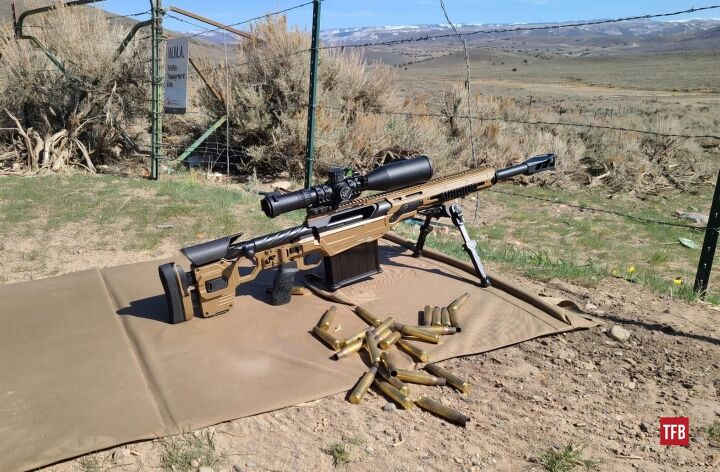
I also did some shooting with emeritus TFB writer Austin when he was reviewing the Cadex CDX-50 Tremor. That is an awesome little .50 BMG designed to fit in the trunk of a police car with the stock folded. It was extremely accurate and easy to shoot, but the muzzle blast was noticeable. Thankfully, we were shooting outside, but as you can see in this picture, the blast wave is pronounced!
Austin shooting the Cadex CDX-50 Tremor
The pernicious thing about overpressure is that wearing ear protection does not prevent the damage. The shockwave is bouncing your brain off your skull, not traveling into your ears and damaging them. Moving indoors amplifies this effect, trapping the pressure and reflecting it off surfaces.
Thankfully, there is a device that reduces the shockwave emitted from the muzzle! Silencers are an ideal solution for limiting this overpressure exposure. The New York Times mentions them at the end of the article, observing that they are more common in military and law enforcement contexts and illegal in some jurisdictions. It also observes that blast diverters were effective in their testing, reducing measured PSI from 1.7 down to 0.5.
The piece ends with a quote from someone you may know, Lucas Botkin. He stated that “concussive damage from shooting is a big reason muzzle devices like suppressors should be widely used.” I agree, Lucas!
Next week, we will look at just how much a silencer can do to reduce overpressure exposure.